

Today’s Energy Surplus May Be Tomorrow’s Supply Squeeze
Ohio’s energy markets are sending businesses two very different signals.
Natural gas remains relatively inexpensive and well supplied today. At the same time, forward electricity prices are facing increasing pressure from rapidly growing demand, capacity shortages, transmission constraints and the need for new generation.
The bigger question is what happens if these two markets—currently moving in opposite directions—begin moving higher together later this decade.
Ohio Electricity: Pressure Is Already Building
Whether your business is served by AEP Ohio, AES Ohio, Duke Energy Ohio, Ohio Edison, Toledo Edison or Cleveland Illuminating, the larger PJM supply-and-demand picture increasingly matters.
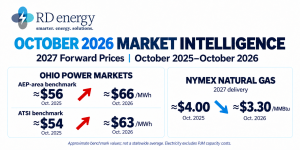
Our latest forward-market data provides a striking example. Over roughly the past year, 2027 AEP Ohio electricity has risen from approximately $56/MWh to $66/MWh, while the 2027 NYMEX natural-gas strip has fallen from approximately $4.00/MMBtu to $3.30/MMBtu.
In other words:
Natural gas became cheaper. Electricity became more expensive.
That’s an important change.
Electricity prices are increasingly being influenced by data-center and industrial growth, generation availability, capacity scarcity, transmission congestion and the enormous investment required to serve new demand—not simply the price of natural gas.
PJM’s latest capacity auction secured 138,318 MW but still finished 6,831 MW short of its Reliability Requirement.
And PJM currently forecasts summer peak demand rising from approximately 160,451 MW in 2027 to 183,008 MW by 2030—more than 22,500 MW of additional peak demand in only three years.
Natural Gas: Abundant Today—But What About 2028–2030?
Natural gas tells a different story today.
Record-level production and healthy storage inventories are keeping prices relatively low. EIA currently estimates inventories could begin the heating season about 2% above the five-year average.
The longer-term picture deserves just as much attention.
U.S. LNG exports continue expanding. Electricity consumption is growing. And additional natural-gas-fired generation is being proposed to help supply the enormous amount of new electricity demand.
The question for 2028, 2029 and 2030 becomes:
Can U.S. natural-gas production continue growing fast enough to satisfy LNG exports, power generation and traditional domestic demand without materially higher prices?
Nobody knows with certainty. That’s precisely why today’s relatively inexpensive forward gas market deserves attention rather than complacency.
Gulf Storm Adds Near-Term Uncertainty.
Tropical Storm Isaias threatens offshore natural-gas production and Gulf Coast energy infrastructure. Production shutdowns could lift prices, while interruptions to LNG exports could temporarily reduce U.S. gas demand and offset that pressure.
RD Energy is watching both sides of this balance as the storm develops —another reminder that procurement opportunities can change quickly.
The Wildcard: A Potentially Historic El Niño
This winter could provide another buying opportunity.
El Niño continues to strengthen. NOAA currently sees a greater than 90% probability of a very strong El Niño during fall and winter 2026–27and a 75% probability that October–December reaches a historic strength exceeding previous El Niño events in its record dating to 1950on its current RONI measure.
That does not guarantee a mild Ohio winter. Weather doesn’t work that neatly.
But if this powerful El Niño contributes to a warmer U.S. winter, reduced heating demand combined with high production and healthy storage could push natural-gas prices lower and leave substantial inventories entering spring 2027.
RD Energy would view that as an opportunity—not proof that natural gas will remain inexpensive through 2030.
The Risk We’re Watching
This may be the most important message in our October report.
Ohio electricity is already experiencing upward pressure while natural gas remains relatively cheap.
Now consider what could happen if natural gas begins tightening and moving higher in late 2027, 2028 or 2029.
PJM could simultaneously face:
- Growing electricity demand + capacity scarcity + transmission constraints + higher natural-gas generation costs.
- Natural gas currently provides electricity with a relatively inexpensive fuel input.
- If that changes, another major source of upward pressure could be added to electricity prices that are already confronting structural challenges.
- That is the scenario RD Energy wants customers prepared for before it happens—not reacting afterward.
RD Energy’s October Position
OHIO ELECTRICITY
Opportunity Index™: 94/100 — VERY STRONG BUY/LAYER
For customers with meaningful 2027–2030 open electricity exposure, we believe this is an important time to review forward opportunities.
Don’t assume lower natural gas will eventually produce lower electricity. The market is already showing us otherwise.
NATURAL GAS
Opportunity Index™: 88/100 — STRATEGIC BUY/LAYER
We aren’t advocating buying everything today.
Strong production, healthy storage and a potentially historic El Niño could create another attractive buying window. But we also would not assume today’s abundance will continue through 2028–2030.
Our strategy is to use periods of weakness to gradually build future protection while preserving flexibility for additional opportunities.
The Bottom Line
Electricity risk is already here. Natural-gas risk may be developing behind it.
Electricity: Buy the calm.
Natural Gas: Use today’s abundance to prepare for tomorrow’s tightening.