


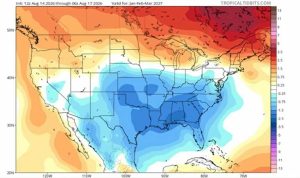
For much of this summer, natural gas & electric buyers have had good reasons to remain patient. Record U.S. production, healthy storage levels and temporary LNG maintenance have helped suppress natural gas prices. For some Buyers there are two additional reasons we hearing for waiting:
“A very strong El Niño could give us a warm winter and much lower natural gas prices.”
“September through October is shoulder season. Prices should get cheaper this fall.”
Both arguments have merit. But the energy market is beginning to remind us why waiting for the perfect bottom can also carry significant price risk.
Natural Gas Is Beginning to Move Up
Natural gas recently climbed to its highest level in about a month. That’s important because several bullish forces that were temporarily muted this summer are beginning to re-emerge.
Freeport LNG terminal maintenance is nearing completion, potentially returning roughly 2 Bcf/day of LNG export capacity to Demand. This is a market mover change.
At the same time, European natural gas storage is unusually low heading toward winter, increasing Europe’s need to compete for global LNG supplies. Add geopolitical uncertainty and disruptions to other global LNG supplies, and suddenly U.S. natural gas isn’t simply a domestic commodity. American consumers are increasingly competing with the world for U.S. natural gas supply. With European prices nearly 20X higher than U.S. prices, soon every drop of LNG that can be exported will be exported.
Manufacturers, schools, municipalities, restaurants and other businesses increasingly compete indirectly with:
- LNG exporters
- Power generators
- Data centers and other large new loads
- Growing industrial demand
- International buyers willing to pay substantially higher prices for LNG
All of this doesn’t guarantee higher prices tomorrow, but it doesn’t help prices work much lower than they are now.
What About the “Super El Niño”?
This may be the biggest reason some buyers are waiting. The logic sounds compelling:
Strong El Niño + Warm Winter + Strong Production + Healthy Storage = Lower Natural Gas Prices
And that scenario absolutely could happen. A very warm winter could reduce heating demand, increase storage surpluses and potentially create another excellent buying opportunity.
But here’s the problem with assuming:
The energy traders in the market already knows El Niño is coming. It already knows U.S. production is strong. It already knows storage is healthy. And it already knows September and October are traditionally lower-demand shoulder months. Those aren’t secrets. For prices to collapse significantly, actual conditions may need to become even more bearish than what the market already expects. And even a very strong El Niño does not guarantee that every part of the United States experiences an exceptionally warm winter. Actually, early forecasts from a variety of long-range weather models are mentioning extremely warm temperatures in far northern U.S and Canada and high pressure system blocking over Alaska and Greenland that could push the coldest air into the Midwest. Even if overall temperatures average milder than normal for the Midwest, it looks very likely we’ll see quite a bit of cold and snow at times too.
Don’t Try to Perfectly Predict the Bottom
This is one of the most important principles behind RD Energy’s procurement strategy: We don’t need to perfectly predict the market bottom to make an excellent energy decision. Waiting indefinitely for the lowest possible price can become just as speculative as buying everything at once. Instead, successful energy procurement requires understanding both sides of the market. That’s why RD Energy continually monitors wholesale electricity and natural gas markets, forward curves, weather, storage, LNG exports, power generation, PJM capacity, transmission costs and emerging demand. Our goal is to identify periods when the risk/reward favors the buyer and help our clients act strategically. Then we shop our portfolio of electric and natural gas suppliers for the lowest custom price when we all agree that the time is right.
And Don’t Forget Electricity
Natural gas isn’t only a natural gas issue. It is also one of the most important fuels used to generate electricity. When natural gas prices rise, the cost of producing electricity can rise with them. But electricity buyers face additional pressures that have little to do with today’s natural gas price:
PJM capacity costs.
Transmission increases.
Data-center demand.
Generation retirements.
Slow development of replacement generation.
Growing competition for future power supply.
That’s why waiting for a lower natural gas price doesn’t necessarily mean future electricity prices will follow it lower.
The Bigger Issue: 2027–2030
This is where RD Energy believes buyers should be looking beyond today’s market. A bearish fall or even a warm 2026–27 winter could create an attractive buying opportunity. But it doesn’t eliminate the structural issues developing farther out. U.S. natural gas demand is expected to grow from LNG exports, electricity generation, data centers and industrial development. Electricity demand is growing after years of relatively stagnant load growth. And the infrastructure needed to produce and deliver additional electricity and natural gas doesn’t appear overnight.
That’s why a short-term price decline and a long-term bullish market can exist at exactly the same time.
That distinction is extremely important. If El Niño or shoulder-season weakness creates lower prices this fall, we want to recognize and potentially capitalize on that opportunity. But we don’t want to assume today’s bearish fundamentals automatically eliminate the much larger risks developing for 2027, 2028, 2029 and beyond.
RD ENERGY’S SEPTEMBER MESSAGE
Don’t fear the market. Don’t chase the market. And don’t simply wait for the market. Have a strategy.
For organizations that already have favorable energy contracts in place, now is the time to understand what comes next — sometimes years before those contracts expire.
For organizations approaching a contract expiration, this is the time to understand your options rather than waiting until you’re forced to buy whatever the market happens to offer.
And for businesses that haven’t reviewed their energy procurement strategy recently, ask yourself a simple question:
If energy prices are substantially higher several years from now, will you wish you had investigated your options today?
RD Energy’s role isn’t simply to obtain supplier prices. It’s to provide the market intelligence, expertise and coaching necessary to help organizations make better energy decisions — before the market makes those decisions for them. Have a strategy for what you’ll do if prices go lower — and what you’ll do if they don’t.